




Our congregation recieved two Torah scrolls from the Trust. We are very grateful for these loans.
Website: memorialscrollstrust.org/
Many Torah scrolls were destroyed during the Second World War, but a considerable number survived, albeit often damaged. The Memorial Scrolls Trust was founded in London with the aim of collecting surviving examples from the Czech Republic, repairing them and lending them to Jewish communities for a small fee. These Torah scrolls live on in numerous Jewish communities around the world, are used again and tell their story. The Trust owns around 1600 Torah scrolls, of which over a thousand have already been loaned out.
Torah scroll from Brno
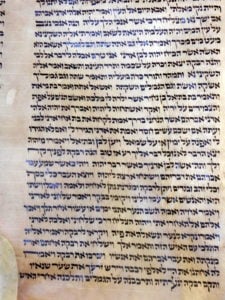 On 27 August 2017, our scroll, originally from Brno (Brünn), was ceremoniously inaugurated. We are very pleased that we are able to use this Torah scroll in memory of a lost Jewish tradition, which is thus being revived.
The presence of Jews in Brno is documented for the first time in the mid-thirteenth century. From 1333, the community was autonomous with its own community institutions such as schools and synagogues, financed by a community tax.
During the Hussite Wars in the 15th century, the Jews were also increasingly persecuted and finally expelled from the city in 1454. Most of them then lived in the neighbouring villages. Although they were allowed to trade in the city, they were not allowed to live there or form their own communities.
It was not until the revolutionary year of 1848 that Jews were given equal rights, could live wherever they wanted and all professions were open to them. At the end of the 19th century there were 7,000 Jews living in Brno, by 1941 there were 11,000. The majority of the Jews were first deported to Terezin (Theresienstadt) and then to Auschwitz, where most of them were murdered. Only just under 700 Jews survived. Today there is a small Jewish community of 300 members in Brno, and one of the less damaged synagogues has been restored.
Tora scroll from Prostějov
Migwan acquired our beloved small scroll in 2018. It is scroll number 557, one of 1564 scrolls brought to Westminster Synagogue in London in 1964, once they were released from the Prague, capital of the Czech Republic. The scrolls from the Jewish Communities of Moravia had been carefully numbered, and its synagogue town named. These scrolls were acquired largely between Kristallnacht in 1938 and 1942 when the communities were decimated and the Jewish “artifacts” sent by the Nazis to the infamous Jewish Museum in Prague, and stored there during WWII. Scroll number 557 had been written by the kosher sofer of the area in the middle of the 19th century. Despite antisemitism and even pogroms dating back to 1919, our scroll had been in regular community use by the Jewish community of Prostějov, a town in the area of Czechoslovakia known as Moravia.
Prostějov is located about 16 kilometres (10 mi) southwest of Olomouc and 45 km (28 mi) northeast of Brno. It lies mostly in a flat agricultural landscape of the Upper Morava Valley. The western tip of the municipal territory extends into the Drahany Highlands and includes the highest point of Prostějov at 368 m (1,207 ft) above sea level. The city is situated at the confluence of the Romže River and Hloučela Stream, which is located in Vrahovice.
In 1869, thanks to the Jewish community in particular, Prostějov has become an important commercial and industrial centre. Mass production of textile clothing began in the 1840s and at the end of the century, the textile industry gained a privileged position in the whole of Austria-Hungary (one-third of the state's total production was from Prostějov). In the late 19th century, Prostějov was the third largest city in Moravia after Brno, the town of origin of our other Czech scroll, and Jihlava.
In the Austrian Empire and Austria-Hungary, Prostějov was part of the Margraviate of Moravia. In 1918, it became part of independent Czechoslovakia. The period of German occupation lasted from March 1939 until May 1945. During this time, Prostějov was administered as a part of the Protectorate of Bohemia and Moravia. The Jewish community basically disappeared as a result of the Holocaust.
During the socialist period, prefabricated housing estates were built on the outskirts of the city (built in 1963–1990) and extensive demolitions took place in the historic centre.
Today we are part of a world-wide effort to maintain a spiritual connection with the former community owners of the Czech scrolls. Just as that community which completely perished during WWII had loved and carefully maintained their scroll, so we now read from it, take care of it, and contribute financially every year to the Czech Memorial Trust, helping to maintain the legacy of Jewish life and traditions in Bohemia and Moravia. In Migwan, we read the sacred words from our scrolls on shabbat and festivals, and every Bar or Bat Mitzvah child is honoured to hold it, lift it, dress it and, together with the whole community, walk with it in procession.